
Home > Why the “L” Comes First: The Lesbian Community and Direct Care During the Height of AIDS
Why the “L” Comes First: The Lesbian Community and Direct Care During the Height of AIDS
by Saruh Lacoff
When it comes to HIV/AIDS, what we need to get on the same page about real quick is that the United States government and medical institutions failed the queer community. We will not be sugar-coating this. We will not be speaking gently.
The willingness to fail “undesirable” communities—that is, queer men and trans folks—resulted in the global spread of a virus that has infected almost 100 million people since 1981, killing over 44 million. It is still with us: Today, three people are newly infected every minute around the world.
What started in 1981 as “gay cancer” or “gay-related immune deficiency,” aka GRID, spread to communities regardless of sexuality and gender, all because queerphobia resulted in a willingness to neglect the well-being of the queer men and trans folks who were the first to be affected.
But this is not what I’m here to talk about.
I’m not here to talk about how Ronald Reagan will forever be an enemy to the queer community for ignoring the virus and its mass death for four-plus years.
I’m not here to talk about the precious time wasted because of governmental and institutional neglect of the mystery illness that started off only affecting queer men and trans folks.
I’m not here to talk about how even once it became clear that HIV/AIDS was transmitted through bodily fluids, many medical professionals still insisted on avoiding all contact with those in their care.
I’m not here to talk about a dehumanizing and isolating experience for those who often died alone, scared, and abandoned by the systems and people that were supposed to support them.
I’m not here to talk about how cemeteries and funeral homes refused to accept the deceased.
I’m not here to talk about how many queerphobic families chose not to take in their children to die in a supportive environment.
I’m not here to talk about how the neglect of the virus meant that our community members were attending multiple funerals a week—sometimes in one day.
I’m not here to talk about how we routinely leave trans individuals out of the conversation when it comes to talking about who the virus impacted.
All of that must be spoken about and must bring about a personal and cultural reckoning.
What I am here to talk about are the people who showed up en masse to support those affected.
I am here to talk about the lesbians who acted as end-of-life doulas and caregivers for the queer men and trans folks living with and dying of HIV/AIDS.
As end-of-life doulas, we know the many ways that this work is applied. Setting up advance care directives, emotional support, legacy projects; navigating relationship dynamics, personal care, and advocacy—these are just a few ways that we support our dying people and their circles of care.
For lesbians at the peak of the AIDS crisis, it became clear that no one was coming to help our queer brothers and sisters who were suffering, and that between familial failure, institutional failure, and governmental failure, the communities hardest hit needed extraordinary amounts of help in so many ways.
All around the country, lesbians began showing up for the community, whether they knew the people dying or not. We see the examples of so many women-loving women who sat at the bedside of dying individuals to hold them, fulfilling a need for physical touch that was otherwise painfully unmet at a deeply vulnerable and scary time. Their willingness to risk personal safety to honor the humanity of the dying person was a risk that most medical professionals and family members were unwilling to take.
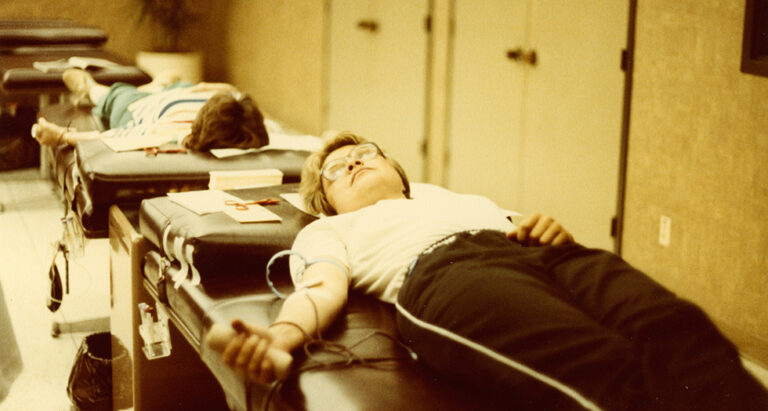
We see the example of the Blood Sisters holding blood drives in many cities to address the blood shortage and provide hope for those needing blood transfusions.
The example of Candy Marcum and Howie Daire in Dallas creating the Buddy Project that matched people with HIV/AIDS with a healthy individual so that they would not be alone as they battled their illness. Candy became Howie’s buddy when he became ill and took care of him alongside his mother. She offered free counseling sessions for the community members who could not afford to pay her as they were dying. And Candy was there with them as they passed.
The example of Dr. Kristen Ries and her partner, nurse and physician assistant Maggie Snyder, who were the only medical professionals who would see HIV-positive individuals in Utah for a significant amount of time. Seeing the emotional toll that a lack of physical contact took on their patients, Dr. Ries and Snyder instituted a policy that all caregivers in their practice must engage in physical contact with their people. From hand-holding and shoulder-touching to a hug after every visit, this contact worked to break the stigma and isolation that so many HIV-positive queer men and trans folks experienced.
The example of Jewel Thais-Williams, who turned her nightclub into a community center by day to provide education and services to the Black LGBTQIA2S+ community who were navigating infection. Jewel started the Minority AIDS project in 1987 when it was still believed to be a white gay man’s disease. Her work involved coordinating doctors traveling to Mexico to procure interferons to provide to the community and organizing fundraisers for the community out of her club.
The example of Bishop Yvette Flunder, who ran an underground Compound Q clinic out of the basement of her church before it was approved by the Food and Drug Administration. The bishop began working in the faith community to shift perceptions around queerness, sin, and HIV/AIDS as punishment. She shared in reflections, “We had to fight back. We had to do something. We couldn’t just see some of the best and brightest people in creation, to continue to see them just die and die horrible deaths. When you’re up and healthy and strong—it took AIDS a while to kill them, but it was a horrible, hard, and difficult death for many of them.”
The example of Jacquie Bishop, who started working as an unofficial medical assistant at the Gay and Lesbian Community Center in New York City at the age of 19. Jacquie took care of every gender of person with HIV/AIDS—including taking blood without gloves in order to provide skin-to-skin contact in a destigmatizing manner.
These women—these lesbians—were end-of-life doulas. They were community supporters. They were the ones who ran into the burning building when nearly everyone else chose to run out. We as deathcare workers understand the power of remaining present even in the face of deep discomfort, tension, and inequity. We face head-on the things that so many others are unable to. The work of the lesbian community during the height of the HIV/AIDS crisis was revolutionary, radical care at end of life. These women advocated for those with little to no power. They brought courage to face the unfathomable.
And that revolutionary care is why the L comes first in LGBTQIA2S+.
I hesitate to make this a feel-good story. I want us all to know this mostly invisible story so that we know how powerfully our communities came together to care for each other. I want us to recognize the beauty and unity of the queer community, one that is too often crushed under the weight of repression and isolation. I want us to know all of the beautiful and powerful details of these stories, and I also want us to remember that much of this should never have been necessary.
I want us to uplift the incredible work of the lesbian community, while recognizing that their tireless efforts could have been alleviated if our government and institutions had done even the bare minimum to respond to the unfolding crisis. I want us to recognize that lives were cut short needlessly and that so much love, culture, and joy was lost because of systemic queerphobia. I want us to recognize that many of the individuals who showed up to care for others also had put on hold their dreams and aspirations to care for their fellow queer community members, because our systems refused to do so. I want us to hold both the heroics of love in one hand, and the sharp edge of indictment of inhumanity in the other.
Posted 6/9/2026