
Home > Doula Profile: Sophia Anjum
Doula Profile: Sophia Anjum
Sophia Anjum is an ancestral healing practitioner, psychopomp, and INELDA-trained end-of-life doula working at the intersection of Islamic spirituality, South Asian cultural traditions, and shamanic practices. She supports individuals and families navigating death, grief, and ancestral wounds through a culturally resonant framework. She resides in Lahore, Pakistan, where she cares for her aging parents while raising her two children and an ever-growing family of cats.
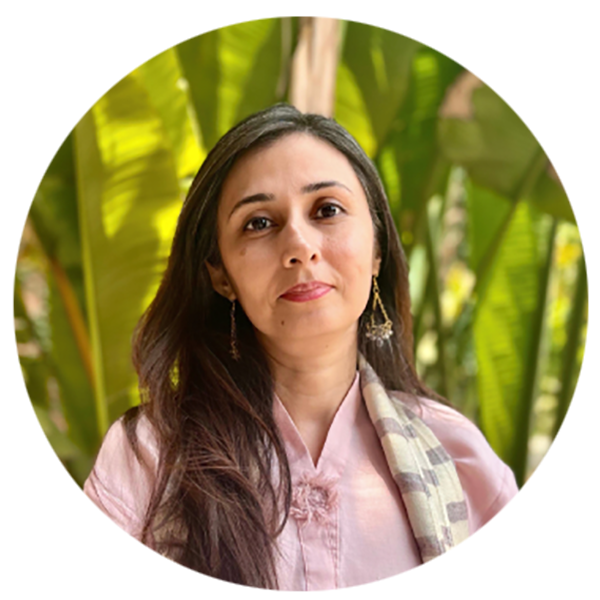
Q&A with Sophia
When and why did you decide to become an end-of-life doula?
I came to end-of-life doula work as a natural continuation of my training as an ancestral healing practitioner and psychopomp. In many ways, I see this as reclaiming work that my ancestors once did—sacred death companionship that existed long before colonization and the rapid industrialization of the modern world fragmented our traditional death practices.
What is your pathway to practicing as a doula?
The term “end-of-life doula” doesn’t exist in my cultural vocabulary. In Muslim communities, particularly in Pakistani/South Asian contexts, death and dying are held within the family as sacred obligations, guided by Islamic rites and kinship bonds. Therefore, my pathway to practicing this work is indirect but deeply intentional. As an ancestral healing practitioner and psychopomp, I work with souls in transition through healing lineage wounds or guiding the dying across thresholds. These are concepts that resonate within our cultural and spiritual framework. People come to me for ancestral healing, and within that container, death work naturally emerges. At times, I may never meet the dying person. The work might stay completely private, radiating into the family system through the one person I’m supporting.
What type of environment do you work in?
I work primarily in liminal spaces—the threshold places where souls and families are in transition. This usually means private, one-on-one settings over video calls or in homes. The environment is less about physical location and more about the energetic container we create for soul work.
What do you do before you meet with a new client?
As mentioned above, my work happens in a roundabout way—people come to me for ancestral healing or psychopomp work, not specifically for end-of-life support. So my preparation involves holding space for whatever wants to emerge. If, during our session, the need for end-of-life work becomes clear, I’m ready to meet that threshold. Before sessions, I do my own ritual work, asking to be shown what this person truly needs and preparing to step into—or take the client on a journey to—whatever portal opens up.
Can you share a short anecdote or insight that changed you?
I have witnessed death in hospital emergency rooms where a soul is transitioning to the other world while doctors and nurses continue their routine, sometimes joking with each other or discussing what to order for dinner. At times, the bereaved family members are told to keep it down because this is a public place. Then there’s the rush to sign paperwork, to empty the bed for the next patient.
I don’t blame the hospital staff. They witness death multiple times daily and they cannot carry grief for every passing or they wouldn’t survive their work. But witnessing this made me realize that there was no one present whose job it was to simply care. No one to hold sacred space for the transitioning soul. No one to acknowledge that something momentous had just occurred, even with a few moments of respectful silence. These experiences stirred something in me about restoring sacred presence to death. Someone needs to be the keeper of that threshold, to ensure the soul is witnessed, honored, and accompanied with full attention and respect.
Who has been one of your teachers or mentors?
I’m immensely grateful to my teachers, Dr. Daniel Foor and Shannon Willis, and to my mentor Michelle Ayn Tessensohn, for guiding me through the realms of the ancestors and helping spirits, and for giving me the confidence and courage to follow the path of my ancestors.
I’ve also been inspired by the teachings of Ibn Arabi, the 12th-century Sufi mystic and philosopher. His writings on the barzakh—the threshold realm between death and resurrection—and the journey of the soul through spiritual stations have given me the Islamic framework for understanding ancestral and psychopomp work.
What do you wish you had known when you started as a doula?
I wish I had known sooner that this work could exist in my context at all. For years, I assumed end-of-life doula work was a Western practice that had no place in my culture. I wish I’d understood earlier that the work doesn’t necessarily have to look like what’s in the training manuals—that it can happen “in the roundabout way,” through ancestral healing and psychopomp practices, and still be profound and necessary.
I also wish I’d come to this work much sooner in my life. Death work has taught me so much about living—about what truly matters, about being present, about the weight of unfinished business and unspoken grief. I wish I had that perspective towards life very early on.
Do you have any words of encouragement for fellow doulas?
This is profound, deep, and sacred work that we are doing. In the face of systems that continue to fail communities and families through their most intimate and vulnerable moments, please don’t give up. Your presence matters—even when it feels invisible, even when the work happens in the margins, even when you wonder if you’re making a difference. Someone’s soul is being witnessed, someone’s grief is being held, someone’s threshold is being honored because you showed up. That matters more than we can ever fully know.
What is your dream for your practice or doulas in general?
My dream is to build a practice where this work can be done more openly, where there can be a recognized role, even within hospital settings and traditional contexts, for someone whose sole purpose is to hold sacred space for the dying and their families.
I envision practitioners who can move between the medical and the mystical, who can be present in emergency rooms and ICUs not to perform medical tasks but to ensure that no soul transitions in a space of casual indifference. Someone who can stand witness, who can create moments of silence and reverence in the midst of institutional efficiency, who can be present during ritual washing to hold the energetic container, so it remains sacred rather than becoming routine, who can support families not by taking over their duties, but by supporting them throughout the process.
Contact Sophia
Web: Whispers From the Beyond // Email: [email protected] // Instagram: @whispers.from.the.beyond
Posted 3/24/2026