
Home > Resources > The Good Death: A Guide for Supporting Your Loved One Through the End of Life | Suzanne B. O’Brien, RN
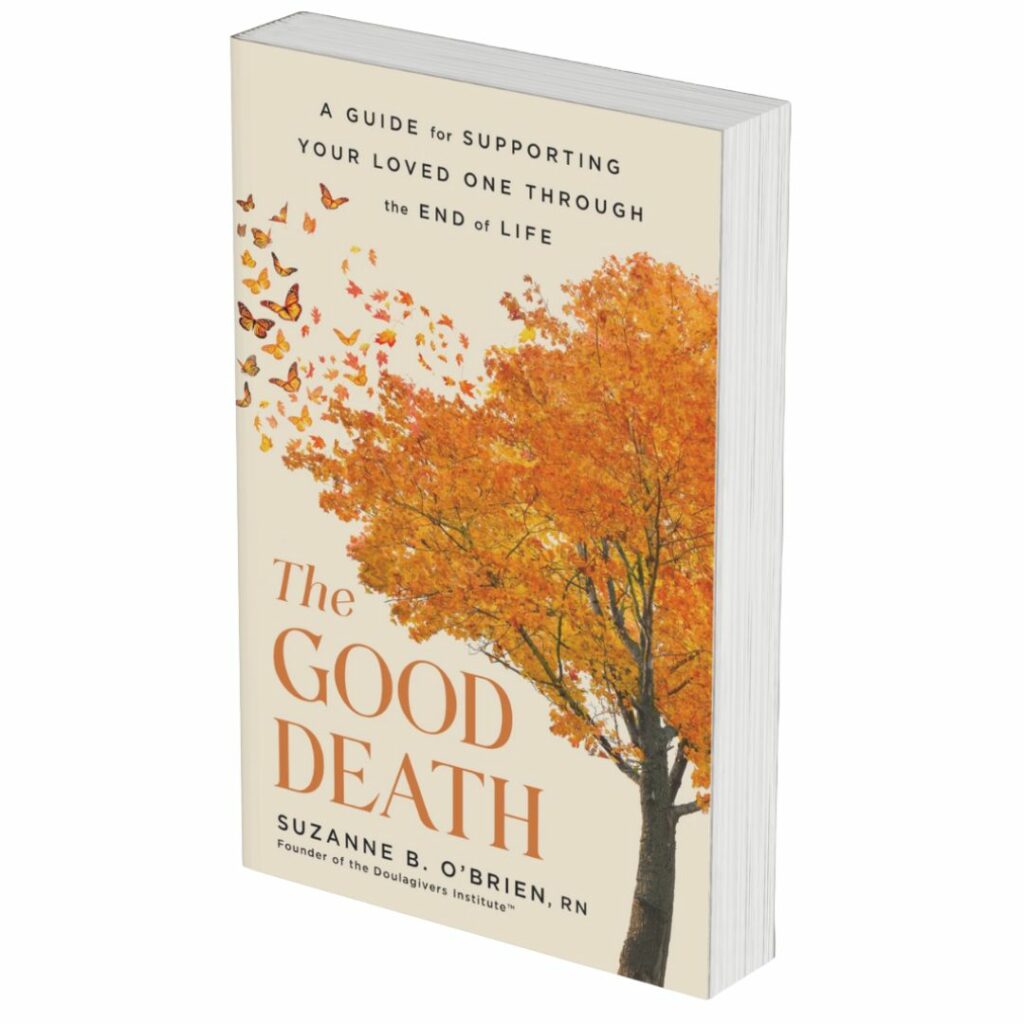
The Good Death: A Guide for Supporting Your Loved One Through the End of Life
By Suzanne B. O’Brien, RN
Suzanne B. O’Brien, RN, is an award-winning hospice and oncology nurse, international speaker, and founder of Doulagivers Institute. As the bestselling author of The Good Death: A Guide for Supporting Your Loved One Through the End of Life (Little, Brown Spark, published March 19, 2025), Suzanne has trained hundreds of thousands of end-of-life doulas and family caregivers worldwide. Her mission is simple yet profound: to ensure that every person has the opportunity to die well—with dignity, comfort, and choice.
In these excerpts, Suzanne shares practical, compassionate strategies to address what she calls the elder care crisis. She explores how longer lifespans, rising costs, and limited care resources are colliding—and how families can avoid crisis by creating a Living Well Aging Plan before it’s too late.
Excerpt 1
Preparing for Longer Lifespans: The Elder Care Crisis
Marcia’s story is one I hear far too often. When her mother’s advanced Parkinson’s disease required live-in care, her father resisted bringing a nurse into their home, but also didn’t want her in a nursing facility. With few options, Marcia scrambled to find a nearby nursing home so her father could visit. She eventually found one, and Medicaid covered the cost—until her father died first. The house was now in her mother’s name alone, making her ineligible for coverage.
In the midst of grieving her father, Marcia faced a tangle of legal and financial roadblocks. She nearly lost guardianship of her mother before a lawyer friend cosigned a bond so she could sell the family home to pay for care. Her mother lived another nine months, but Marcia calls it “the most stressful experience of my life.”
Sadly, this is not unusual. Most families wait until a health crisis forces urgent decisions—often without knowing their loved one’s wishes. With life expectancy nearly doubling over the last century and the senior population projected to double again by 2050, these scenarios will only become more common. The U.S., like many countries, lacks the systems and infrastructure to care for an aging population adequately. Rising costs and limited resources mean we must take matters into our own hands—and early.
Excerpt 2
Living Well Aging Plans: A, B, and C
At Doulagivers Institute, I teach families to create three versions of a Living Well Aging Plan:
- Plan A: The best-case scenario. If there were no physical, mental, or financial limitations, where would you want to live and how would you spend your time?
- Plan B: If some physical or mental limitations arise but you are still mostly independent, what changes would make life easier? (E.g., main floor bedroom and bathroom, moving in with family, assisted living.)
- Plan C: If you became completely incapacitated and required 24/7 care, where would that care take place? Who would provide it? What resources are available—Medicaid, community programs, or private care?
By creating these plans in advance, you avoid the emotional and financial chaos of making decisions during a crisis.
The Reality of Costs
The average private nursing home room in the U.S. costs $9,000–$15,000 per month, while assisted living facilities average $4,000–$5,000 per month. Even substantial savings can be depleted quickly. Medicaid may help, but only after a strict five-year financial review to ensure no large transfers were made to qualify.
Advance Directives and the Health Care Proxy
Aging plans must be paired with advance directives—legal documents outlining medical wishes if you can’t speak for yourself.
These include:
- Living will: Specifies what life-prolonging measures you want or don’t want.
- POLST (physician orders for life-sustaining treatment): A medical order that emergency responders and doctors must follow.
- Health care proxy: Appoints a trusted person to communicate your wishes to medical providers.
Without these, families are often left guessing—and may disagree, sometimes irreparably. Two-thirds of U.S. adults have no advance directives, leaving their fate to default medical procedures designed to prolong life at all costs.
Creative Housing Solutions
Most people want to remain at home for as long as possible. Options include:
- Multigenerational care: Family members share responsibility for care in rotation.
- Granny pods (accessory dwelling units): Small, self-contained living spaces on a family member’s property with accessibility features for safety and comfort.
- Doula communities: Purpose-built, holistic living environments for elders without family support, like the one Doulagivers is developing in Belize.
While some solutions may seem costly up front, they can be far more affordable than institutional care in the long run—and they often offer higher quality of life.
The Doula’s Role in Navigating the Elder Care Crisis
End-of-life doulas are uniquely positioned to help families create Living Well Aging Plans, complete advance directives, and explore creative care solutions before a crisis strikes. We can bridge the gap between overwhelming systems and a family’s deeply personal needs—ensuring elders age with dignity, autonomy, and peace.
The truth is this: Aging is inevitable. Crisis is not. Planning ahead is one of the greatest gifts we can give ourselves and those we love.
Learn More
Join The Good Death Movement
Join Suzanne for The Good Death Live Book Club Experience: 12 Month Death and Dying Course with Suzanne B. O’Brien, RN, a unique monthly opportunity to explore the transformative topics of death and life in a supportive and compassionate space. Join here.
Get your copy of The Good Death: A Guide for Supporting Your Loved One Through the End of Life here (Little, Brown Spark, published March 19, 2025).
Excerpted from The Good Death: A Guide for Supporting Your Loved One Through the End of Life. Used with permission of Little, Brown Spark
Posted 9/10/2025