
Home > Resources > The Safari Concept: An African Framework on End-of-Life Care
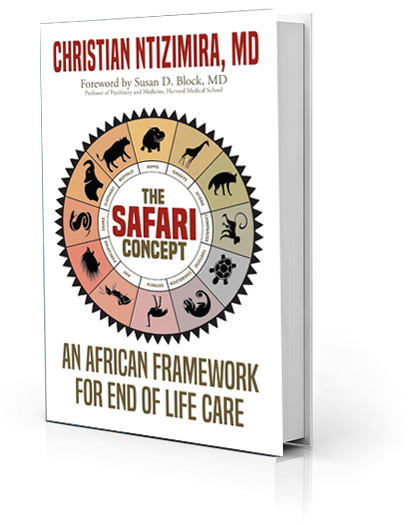
The Safari Concept: An African Framework on End-of-Life Care
By Christian Ntizimira
The Safari Concept is a groundbreaking approach to palliative care that transcends cultural and linguistic barriers. By recognizing the importance of family and community in African cultures, the concept invites those around the dying person to participate with medical caregivers in decision-making and care, as they have for millennia. Using animal archetypes as metaphors, the concept provides a powerful framework for characterizing patterns of a family’s suffering and identifying the health care team’s most effective responses for addressing their physical, emotional, and spiritual needs. Dr. Christian Ntizimira’s book, The Safari Concept: An African Framework on End-of-Life Care (Batinya Publishing, 2023), shares how this can come to life.
Excerpt
My Lessons From Families
Culturally Sensitive Communication
Early in my practice, a patient’s relative told me that I knew how to talk but not communicate. He meant I created logical sentences and used correct medical terms, but I failed to convey a sense of humanity and compassion in my practice. I had learned the language of medical science but not of families or communities. After my palliative care training, I realized I needed to go beyond the traditional hierarchy of the doctor-patient relationship. I learned to use nonverbal communication to put people at ease, to listen more than I spoke, and to listen not only with my ears but with my heart.
As the patient’s family was a lifeline in providing emotional and practical resources such as food, bedding, medications, transportation, and financial support, they were essential to successful medical treatment. Rather than avoiding them as difficult, I wanted to invite them to participate in care. With our small team providing palliative care in addition to our usual duties, I began to organize family meetings shortly after a patient’s hospital admission. As such meetings were not part of the hospital routine, I attended them alone, without the team, to learn from the process and develop my approach.
Our Collectivistic Culture
First among my lessons was to start from where I was: Kigali, Rwanda. My formal training in the USA needed to be adapted to my cultural context rather than blindly adopted and imposed. The Western individualistic model did not fit our African collectivistic culture that prioritizes interdependence, in which “family” includes not only the nuclear family, but grandparents, aunts, uncles, cousins, friends, neighbors, and beyond.
At my first family meeting in Kigali, I was surprised to encounter eighteen people with eighteen different expectations. I was anxious, the meeting did not go well, and everyone was frustrated. I was discouraged but determined to continue. With no access to family therapy training, I used what was at hand, adopting a Rwandan cultural approach from my experience with my own family, community, and society. I researched the concept of umuryango, the Kinyarwanda word for family, ubudehe, a Rwandan cultural value of mutual assistance among community members, and the role of family hierarchy in Rwandan decision-making. Ubudehe, given its historical and cultural setting, serves as a societal framework that brings together the community, sharing the responsibility of addressing challenges, maintaining societal standards, nurturing social harmony, and ensuring collective governance among neighbors.
Of course, I failed again and again. But every failure taught me lessons that built a more effective process.
The Butterfly Approach to Decisions
It was helpful to reflect on a Rwandan saying, “When you are well, you belong to yourself, but when you are sick, you belong to your family.” The family’s responsibility for an independent healthy adult is limited, specific, and clear. The family may play a role in an adult’s choice of education, religion, place of residence, job, and spouse, but the individual makes the final determination.
By contrast, the family’s responsibility increases when a member is in need, whether through illness or destabilizing circumstances such as trauma, bereavement, divorce, or unemployment. The family (and, by extension, the community) plays a role in helping the individual reestablish wellness, personhood, and integrity. As such, the patient’s autonomy is in dynamic equilibrium with family/community responsibility, and the balance shifts depending on circumstances and needs. I believed that palliative care could help achieve that equilibrium by communicating with both the patient and the family.
In accordance with African collectivistic culture, our palliative care team developed what we call The Butterfly Approach to Decision-making.
In the wing of Patient Autonomy are the person, expectations about care, and privacy. In the wing of Community Responsibility are the family, its resources, and cultural norms. This framework establishes a balance at the intersection of patient and family roles.
As patients consider themselves part of the family and community, that intersection is equally important to fulfill their sociocultural roles at the end of life.
The Butterfly Approach unites the patient and family. It establishes equilibrium, adjusts expectations, and reconciles perspectives that the illness journey may have fractured.
Excerpted from The Safari Concept: An African Framework on End-of-Life Care. Used with permission of Batinya Publishing.
Bio: Dr. Christian Ntizimira is the author of The Safari Concept: An African Framework on End-of-Life Care and the founder and executive director of the African Center for Research on End-of-Life Care (ACREOL), a nonprofit organization bringing sociocultural equality through ubuntu, or the concept of connectedness and compassion, in end-of-life care in Africa. He is a Fulbright alumnus who graduated from Harvard Medical School, Department of Global Health and Social Medicine.
Posted 11/6/2025
Posted 11/13/2025