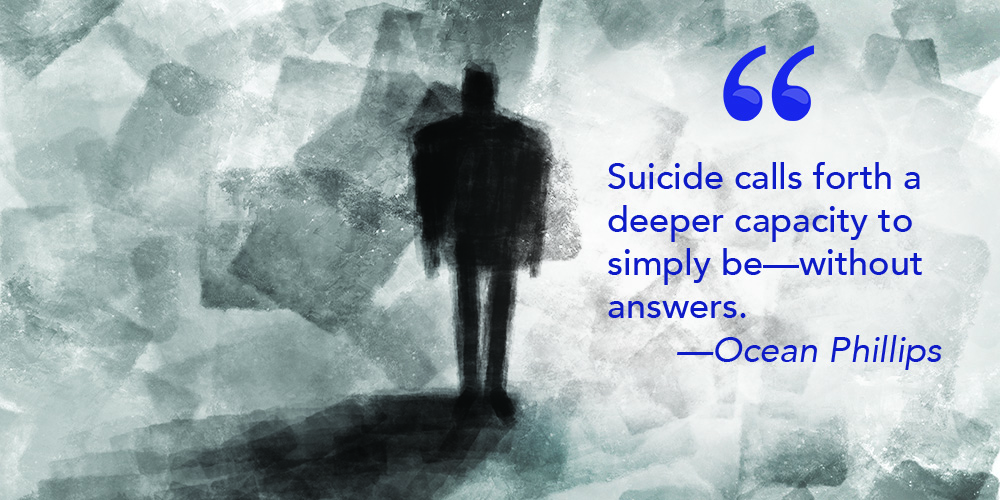
BEING PRESENT FOR SUICIDE
|
by Marady Duran and Ocean Phillips
|
A conversation between Ocean Phillips, an end-of-life doula who offers one-on-one spiritual care for those accompanying the dying, and INELDA educator Marady Duran on how death doulas can support the silence, sorrow, and mystery surrounding suicide.
Marady: We’re sitting together to reflect on how doulas can be present with suicide—and how we might support those who survive a suicide. Can you begin by sharing a bit of your practice and anything you’d like readers to understand as we enter this space?
Ocean: As a hospice spiritual care counselor and a death doula, I live in the threshold between life and death. Most of the people I accompany are in a gradual process of letting go. Suicide is different—it ruptures the anticipated arc of dying. It breaks into silence, and often into shame. It can leave behind a weight that no one knows how to carry.
|
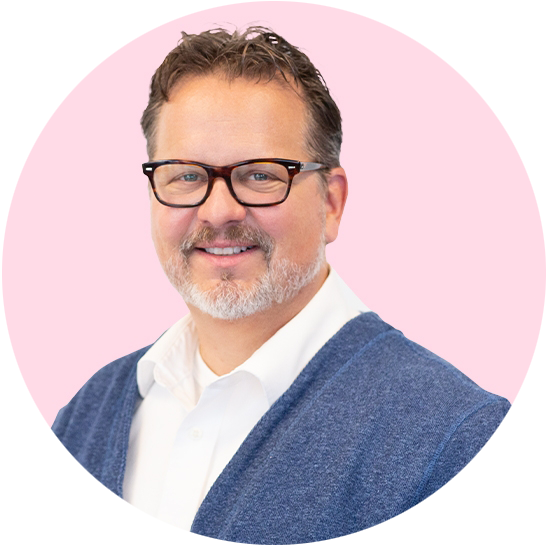
Thomas Waknitz, MDiv, is a professional chaplain and an INELDA-certified end-of-life doula based near Stillwater, Minnesota. He walks alongside residents, families, and staff in all aspects of life and end of life within senior living communities at Lifespark. Thomas also provides spiritual and emotional care for first responders through the Washington County Sheriff’s Office Chaplaincy Corps. He recently joined the board of directors at Brighter Days Family Grief Center, where he helps shape programs for grieving individuals and families across generations.
|
When and why did you decided to become and end-of-life doula?
|
The decision came gradually, like the unfolding of something I already knew deep inside. After years as a chaplain, I saw how often people approached death without the presence and intentional care their spirit longed for. Becoming a doula wasn’t about adding something new; it was about naming what had always been true: that my call is to walk with the beloved through the threshold of life into death with tenderness, courage, and reverence. Death, for me, is not the end but a sacred return, part of the great arc of love.
|
INTEGRATING END-OF-LIFE DOULAS INTO CLINICAL MODELS
|
September 26, 2025
Friday 2pm – 5pm ET
|
Location: ZOOM
Host: Wilka Roig
Price: $130 (10% discount for Tier 1, 2, and 3 Members)
|
3 WEEKEND DAYS END-OF-LIFE DOULA TRAINING
|
October 19, 2025 to November 2, 2025
Sundays, 7am – 4pm ET
|
Location: ZOOM
Host: Omni Kitts Ferrara
Price: $895 (discounts available for members, students & military)
|
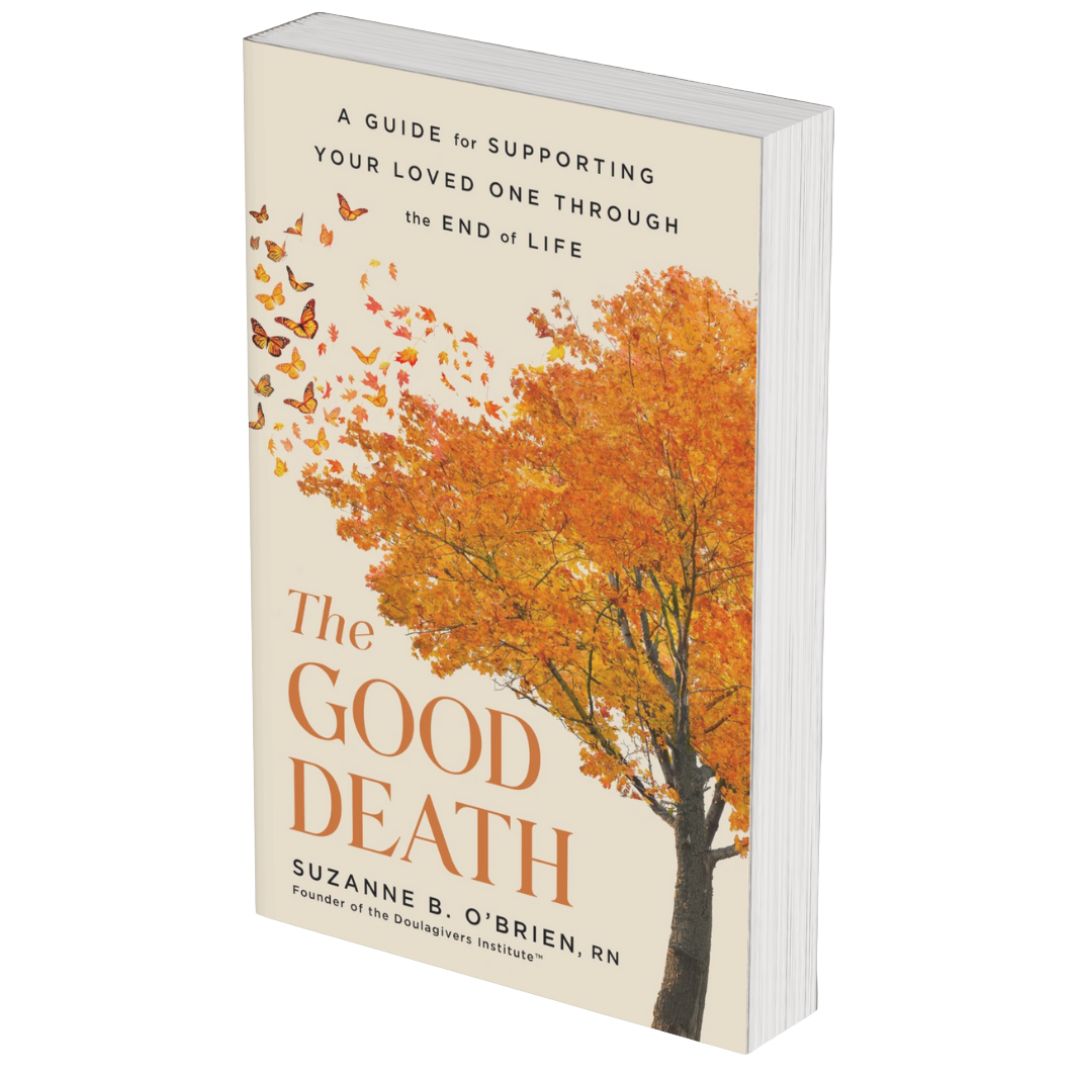
The Good Death: A Guide for Supporting Your Loved One Through the End of Life
|
By Suzanne B. O’Brien, RN
|
Suzanne B. O’Brien, RN, is an award-winning hospice and oncology nurse, international speaker, and founder of Doulagivers Institute. As the bestselling author of The Good Death: A Guide for Supporting Your Loved One Through the End of Life (Little, Brown Spark, published March 19, 2025), Suzanne has trained hundreds of thousands of end-of-life doulas and family caregivers worldwide. Her mission is simple yet profound: to ensure that every person has the opportunity to die well—with dignity, comfort, and choice.
In these excerpts, Suzanne shares practical, compassionate strategies to address what she calls the elder care crisis. She explores how longer lifespans, rising costs, and limited care resources are colliding—and how families can avoid crisis by creating a Living Well Aging Plan before it’s too late.
|
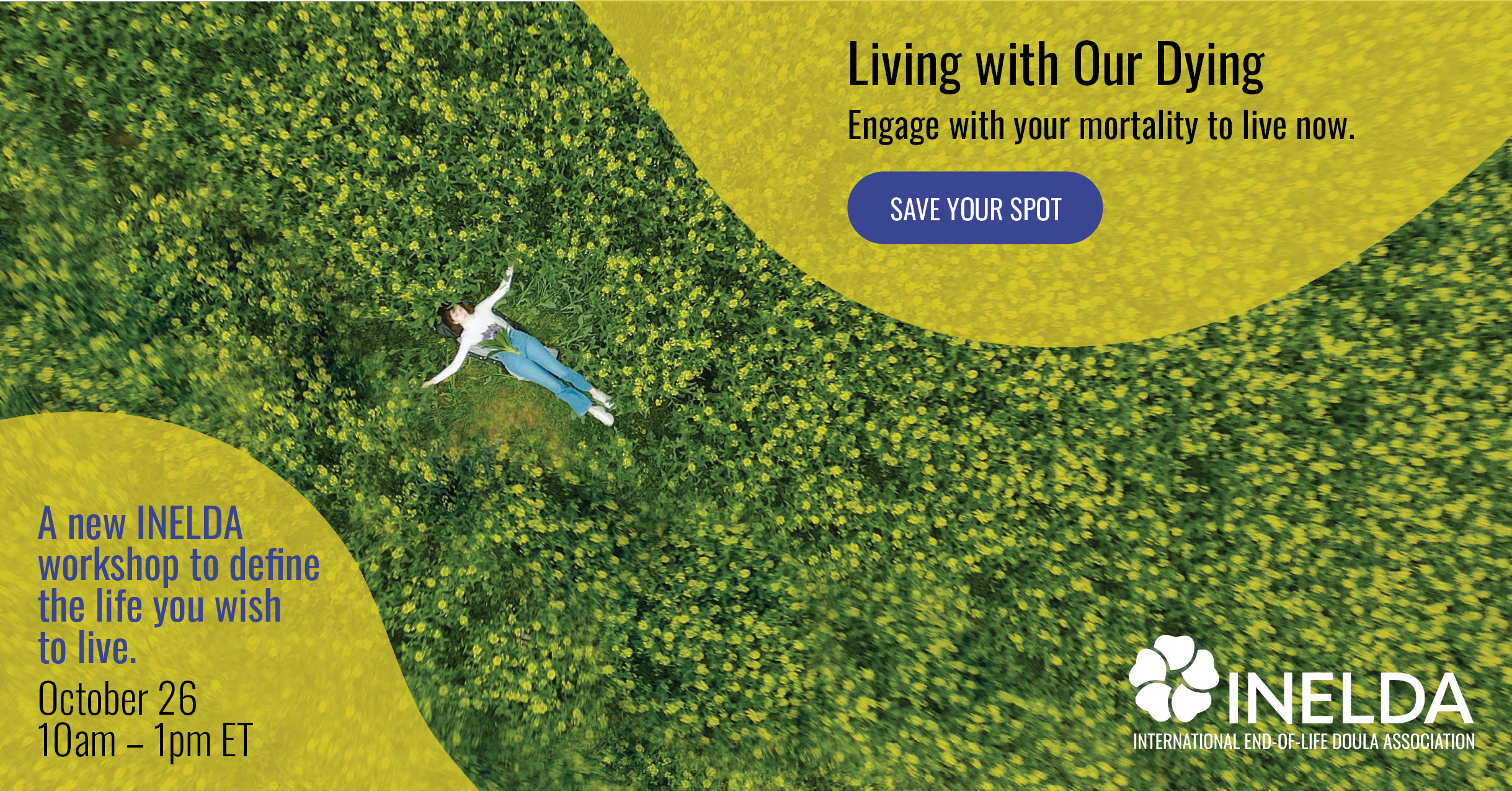
LIVING WITH OUR DYING: A NEW INELDA WORKSHOP
|
by Omni Kitts Ferrara & Wilka Roig
|
INELDA facilitates end-of-life doula training for hundreds of people each month who are dedicated to supporting others confronting dying and death. We seek to sustain spaces in our community to evolve our approach for supporting those facing their own mortality. As human beings, we experience loss, go through seasons of grieving, and face our mortality in subtle and monumental ways throughout life, not just at “the end.” Our new three-hour workshop, Living With Our Dying, invites us to recognize and engage with the undeniable fact that our time on this earth is finite. Pointing to the preciousness of life, to the unique opportunity we have being alive, living with our dying nudges us to consider how we may choose to live more intentionally, honoring what matters most to us while we are still here.
|
We are excited to announce that the INELDA scholarship program has officially reopened this week. The scholarship program is a vital part of our mission to expand access to end-of-life doula training and meet the critical need for doulas in marginalized communities. We are committed to making doulas more accessible to historically underrepresented groups, ensuring that end-of-life care reflects and honors the full diversity of the people it serves.
|
What Matters Most Book Launch October 4
|
What Matters Most: Lessons the Dying Teach Us About Living author and INELDA-certified end-of-life doula Diane Button invites all INELDA doulas to live stream her book launch October 4. This poignant collection of stories highlights the powerful lessons Diane has learned from her “wisdom keepers,” revealing the core elements that contribute to a deep, purposeful existence. The book features the heartfelt narratives of seven INELDA-trained doulas and others, through which “readers are encouraged to reassess their priorities, nurture their connections, and pursue their passions with renewed urgency and appreciation.”
|
Hospice Volunteer Opportunities in New Jersey
|
Swan Hospice, located in central and southern New Jersey, has volunteer opportunities for end-of-life doulas who would like experience and hours. Swan Hospice provides supportive, holistic care that promotes comfort for terminally ill adult patients and security for their families. Its services include nursing homes, assisted living, and home service.
|
Thanatology Around the World
|
September 30 | TUE 7 – 8:30pm ET
|
Thanatology is the study of death, dying, grief, loss, and bereavement. Cole Imperi, the founder of the School of American Thanatology, will join us this month for an engaging conversation moderated by educator Wilka Roig about the history of thanatology, its academic, clinical, and applied approaches, and the differences between thanatology approaches throughout the world.
|
Cole has diverse experience from working in and around loss and grief since 2008. She has worked as a chaplain-thanatologist in one of America’s 25 largest jails, mortuary college professor, crematory operator, hospice volunteer, grief support group leader for children as young as 3 to adults, and death companion, and she has served on the board of a green burial startup and as board president of a historic cemetery and arboretum.
*Please note that due to holidays this webinar will be held on Tuesday, September 30.
|
Cost: This month’s webinar is FREE for ALL INELDA Members | Non-members $15
|
“I always invoice clients in advance. We set up a schedule and I explain that I invoice towards the end of the month for the following month’s services. If they are a short-term client, I invoice for the number of upcoming visits we have agreed upon. I let them know what services begin when payment is received.”
-Carla Parkes
|
Equal Deathcare aims to provide the tools and knowledge to ensure everyone is respected in death, no matter who we are or who we love. The organization teaches marginalized communities how to safeguard themselves and loved ones left behind from unsupportive legal next of kin and indifferent funeral professionals. Equal Deathcare collects nationwide resources and connects people to the deathcare services they need when they need them.
|
The group’s community members educate people about the funeral process, from end of life to bereavement aftercare for individuals and families traditionally left behind by mainstream funeral culture. Equal Deathcare is also committed to continuing research and education for professionals that addresses the unique needs of the LGBTQIA community by providing deathcare workers with a foundational basis of knowledge about how to best serve and support this beautifully diverse community.
|
How can I best set up my doula practice to be by donations? I am assuming people will ask, “What do most people pay?”
—M.B., Pathways to Practice participant
|
Educator Omni Kitts Ferrara: The short answer is similar to any market: It will depend on the going rate in your community. If you can’t find end-of-life doulas, look to the birth doulas in your area. You may also want to factor in how long they have been working. Do they have a lot of experience behind them? In the birth doula world, insurance covers $27 an hour; this can be a starting point for you. Another way to approach this is by asking yourself, “What do I need to survive?” Is that $25 or $60 an hour? Consider what you need to make, and then share your “suggested donation.” This could be at an hourly rate or a range, or you can also determine a flat rate.
|
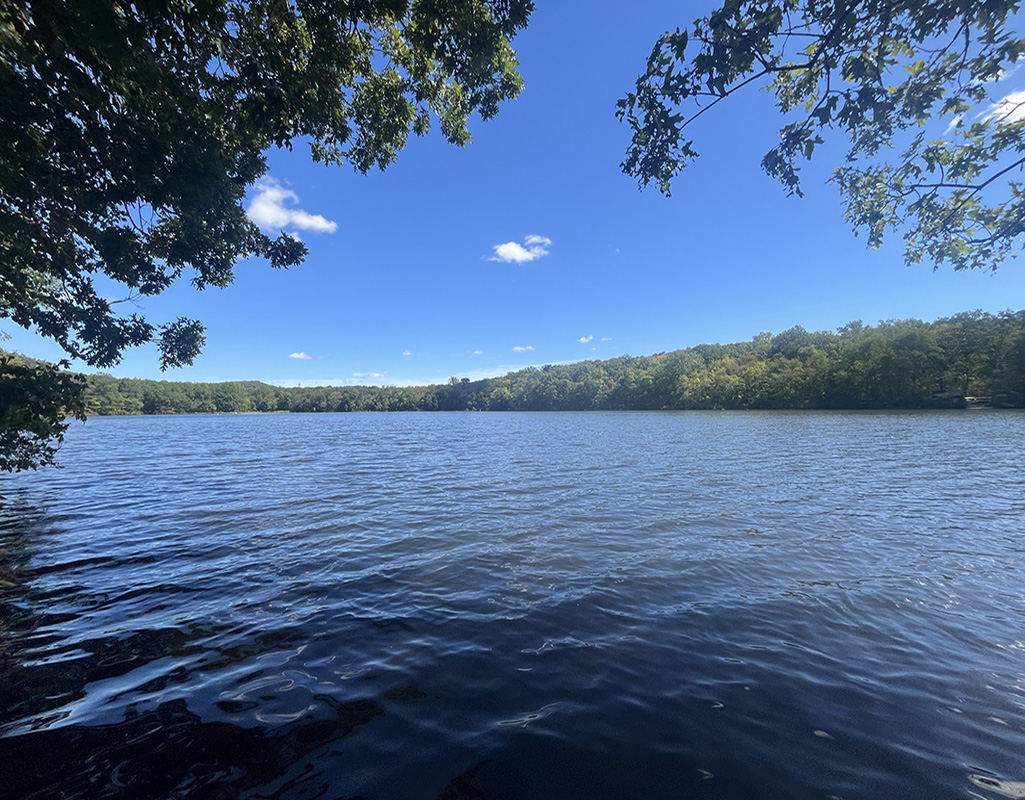
I am writing this lakeside—computer balancing on my lap, fall’s air here to greet me. Metal rowboats bob from the wind, and my senses are heightened between the rustling of the leaves, the morning chatter of the birds, and the chill on the back of my neck. A few leaves are proudly attempting to change color, and all the lotus flowers on the lily pads are holding on to summer. I live for these transitions.
–Loren Talbot
|
Doula Practice Protected by U.S. Appeals Court
|
Telling people about their options at end of life constitutes free speech, according to the 7th U.S. Circuit Court of Appeals—and is thus protected by law. That’s the latest development in the case filed by EOL doula Lauren Richwine, who was ordered by the state of Indiana to obtain a funeral director’s license or shutter her doula business, Death Done Differently. The August ruling means that Richwine can continue practicing as a doula without becoming licensed as a funeral director.
|
Factors Involving Advance Care Directives
|
“Low, static over time, and possibly unequal”: These are the findings of a recent systematic review on the usage of advance directives. The meta-analysis, published in Inquiry: The Journal of Health Care Organization, Provision, and Financing, found a number of factors that indicate the likelihood of having an advance directive. Chronically ill patients, people with a cancer diagnosis, White people, educated people, and women were more likely to complete an advance directive.
|
Self-Compassion Linked to Positive Attitudes on EOL Care
|
Self-compassion isn’t only a useful tool for preventing burnout. It’s also related to attitudes toward end-of-life care, shows new research published in Omega—Journal of Death and Dying. In a study of 219 nurses working in intensive care units in Iran, researchers found that positive attitudes toward caring for dying patients rose in tandem with self-compassion.
|
Death from Natural Causes
|
“Because the deceased left a sort of note, at first they
thought his death was suicide; but the autopay proved
that he died from natural causes.” —News item
have learned much this year
within have grown quieter—much pain
has taught me quiet
demanding less of living have
more of life, turn
more toward the future, seem
mostly healed of the past
think less of my own lacks,
more of bestowing, and my days
seem richer—even in pain and grave illness seem oftener
quick with the miracle and abundance of life
am I finding the soul, where separation
cease and matter is radiance the lotus of
love that flowers in the ultimate heart?
there is white now among the hairs of my head
for much that I have learned
no words
no need for words
|
Support Accessible, Equitable, and Compassionate Deathcare
DONATE HERE
|
© INELDA 2025 International End of Life Doula Association is a
501(c)(3) tax-exempt nonprofit organization that relies on public support to do it’s work.
Tax ID#: 47-3023741
Phone: 201-540-9049
[Account Login]
|
|