
Home > Resources > Never Can Say Goodbye: The Life of a Death Doula and the Art of a Peaceful End
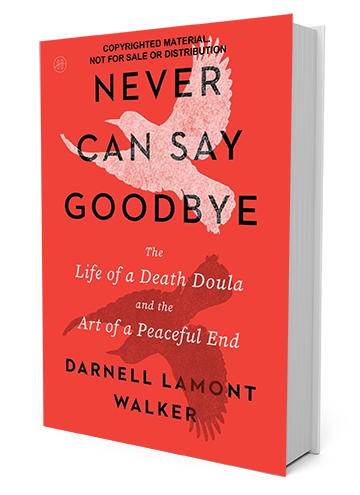
Never Can Say Goodbye: The Life of a Death Doula and the Art of a Peaceful End
By Darnell Lamont Walker
Darnell Lamont Walker, author of Never Can Say Goodbye, is a death doula, Emmy-nominated children’s television writer, producer, and explorer. Born in Charlottesville, Virginia, he creates spaces worldwide for healing through storytelling, end-of-life care, and workshops on grief, resilience, unlocking the writer within, and radical empathy. He joyfully lives in the Chattahoochee National Forest of north Georgia.
Excerpt
Delphine
Just after returning home to my cabin in Georgia from Daytona Beach, Michele called with news of Delphine’s leukemia diagnosis, and the ground beneath us trembled. It doesn’t matter how long I’ve been doing this work or how many people I’ve helped usher to the other side, the initial moment after receiving news like that will always shock me and the words that come from my mouth are usually proof of that. “People like Delphine don’t get sick,” I said, quickly realizing it was untrue. In fact, I have many clients who, by most people’s definition of fairness, shouldn’t get sick and die of anything but old age. Being a death worker will make one reevaluate their notions of “fair.”
Michele walked me through the days leading up to diagnosis as I sat on the other end of the phone silently changing out of my friend clothing and into my death doula threads.
There was a brief silence when Michele stopped talking that I’m sure we both knew was necessary. She’d had days with this news, and I’d only had the last four minutes. I broke that silence with, “How does your mom feel?”
“She’s ready,” Michele responded, her tone telling me she’d sat with that for some time before being able to speak it out loud. Another silence before I asked Michele how she felt about her mom’s decision to not dance with cancer but with the inevitable. “I don’t want to lose my mom,” Michele said with a pause following, and before I could say anything, she added, “but I will respect her decision.” As a death doula in that moment, I knew where to meet Delphine and Michele with any resources, assistance, and words I could gather.
Delphine’s readiness to embrace the end of her life wasn’t unique, but it demanded a level of acceptance and support that transcended personal desires; a level of support that, unlike Delphine’s acceptance, is unique. Too often I’ve seen family members and friends, even those who hold the complete trust of the person actively dying, go against the wishes of that person in order to serve their personal desires. Michele’s willingness to honor her mother’s choice, even in its extreme difficulty, underscored the importance of respecting an individual’s autonomy, especially in what would be their final moments. By listening to Delphine, Michele navigated a path fraught with uncertainty, transforming potential discord into cherished moments of connection. Not everyone who deeply loves the person reaching the end of their life takes this stance. As a death doula, I work hard to get everyone to understand the importance of listening while also understanding why they don’t want to. Sadly, however, what I’ve seen and will undoubtedly continue to see while doing death work is that the people who spend their time attempting to get the actively dying person to change their mind and fight regret wasting so much of that invaluable time in contention.
In the days, then weeks, then months that followed, Michele, unsure of how much time she’d have with her mother, became Delphine’s caregiver with grace. And through informal weekly check-ins, I set out to provide solace and assistance, recognizing the toll caregiving, especially in the end, exacts on the mind, body, and spirit. So often, when deep in the trenches of caregiving, folks aren’t so sure what it is they need outside of rest and respite. This was Michele—unsure, exhausted, but hanging out with the help of an incredible husband and their two daughters. Thank goodness for support systems. As a friend, a person who loved Delphine, and a caregiver who understands the importance of self-care, I called Shannon, my friend from college and Michele’s Delta Sigma Theta Sorority sister, and together we rallied support from our Bethune-Cookman University Wildcat community, assembling care packages tailored to Delphine’s and Michele’s needs.
Delphine’s package, adorned with comforting essentials for the journey she was on—a knitted blanket that felt like a hug when covering the body, electrolyte drops for immunity support and hydration, lavender-scented Epsom salt for soaking, and a journal—symbolized our collective embrace, offering warmth and solace in her final days. For Michele, we put together an album of gift certificates to use when she found herself needing food and certainly didn’t have the energy to cook or even think about where to go. If she needed a tea or a coffee or a croissant to keep going or to attempt to calm her nerves, there were certificates for that. And when she needed something for herself for no reason other than to be distracted, she was covered there, too. This was a gesture of solidarity and love, a reminder that neither of them was alone in this journey. We simply did what friends and family do. We take care of each other. As a death doula, I witness this outpouring of support and my belief in the power of community, especially in moments of profound vulnerability, is affirmed.
Excerpt from Never Can Say Goodbye: The Life of a Death Doula and the Art of a Peaceful End by Darnell Lamont Walker reprinted with permission from HarperOne, an imprint of HarperCollins Publishers. Copyright © 2026.
Posted 2/24/2026